Lorsqu’une blessure du genou fait craindre une atteinte du ligament croisé antérieur (LCA), plusieurs tests cliniques simples permettent au médecin d’évaluer rapidement la stabilité du genou. Voici comment fonctionnent ces tests :
Le test de Lachman
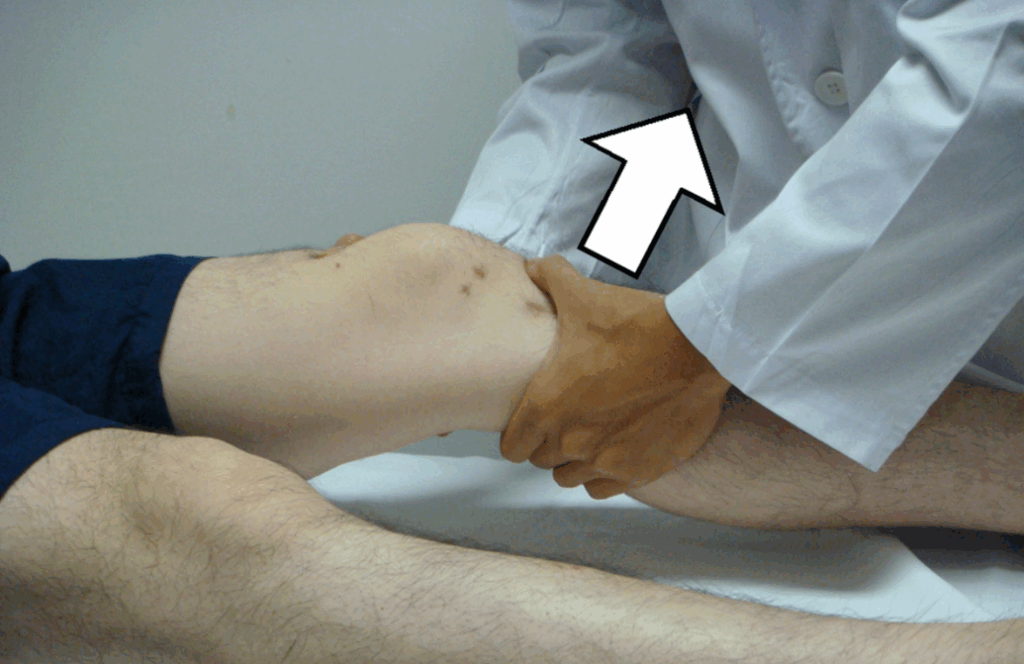
Ce test consiste à plier votre genou à environ 20-30°, puis examiner si le tibia (os du bas de la jambe) avance par rapport au fémur lorsque le praticien le tire doucement vers l’avant. Si ce mouvement est plus évident que sur le genou sain ou avec une sensation « molle », cela évoque une rupture du LCA. Le test de Lachman est reconnu pour sa fiabilité et son utilité, même si sa précision peut baisser dans les ruptures complètes au stade post-aigu. Un test positif permet au clinicien de diagnostiquer une rupture du LCA.
Le test du tiroir antérieur
Pour ce test, le genou est plié à 90°, puis le praticien tire le tibia vers l’avant. Comme pour le test de Lachman, la comparaison avec l’autre genou est essentielle. Ce test est aussi utilisé pour détecter une rupture du LCA, mais il peut être moins précis que le Lachman dans certaines situations
Le test du pivot shift (ressaut rotatoire)
C’est un test dynamique : le médecin effectue un mouvement combiné de rotation et de flexion du genou. Chez une personne avec une rupture du LCA, cela peut provoquer une sensation de « ressaut » ou d’instabilité, reproduisant ce que les patients décrivent lors de certaines activités physiques. Le pivot shift est considéré comme le plus spécifique pour confirmer une rupture du LCA, surtout en l’absence d’autres lésions ligamentaires. Il est parfois moins facile à réaliser si le patient est crispé ou anxieux.[4][5][6][1][3]
En résumé : Ces tests sont complémentaires et permettent de poser un diagnostic fiable. Un test positif permet souvent de confirmer la rupture du LCA, mais l’IRM est devenue indispensable pour confirmer le diagnostic. N’hésitez pas à parler avec votre praticien si vous souhaitez mieux comprendre le déroulement des tests ou les résultats obtenus
- Sokal PA, Norris R, Maddox TW, Oldershaw RA. The diagnostic accuracy of clinical tests for anterior cruciate ligament tears are comparable but the Lachman test has been previously overestimated: a systematic review and meta-analysis. Knee Surg Sports Traumatol Arthrosc. 2022 Oct;30(10):3287-3303. doi: 10.1007/s00167-022-06898-4. Epub 2022 Feb 12. PMID: 35150292. PMCID: PMC9464183.
- Logan MC, Williams A, Lavelle J, Gedroyc W, Freeman M. What really happens during the Lachman test? A dynamic MRI analysis of tibiofemoral motion. Am J Sports Med. 2004 Mar;32(2):369-75. doi: 10.1177/0095399703258698. PMID: 14977660.
- Mulligan EP, McGuffie DQ, Coyner K, Khazzam M. The reliability and diagnostic accuracy of assessing the translation endpoint during the lachman test. Int J Sports Phys Ther. 2015 Feb;10(1):52-61. PMID: 25709863. PMCID: PMC4325288.
- McLeod KC, Cinque ME, Moatshe G, LaPrade RF. Pivot Shift Syndrome of the Knee. Sports Med Arthrosc Rev. 2023 Jun 1;31(2):34-40. doi: 10.1097/JSA.0000000000000365. PMID: 37418172.
- Slette EL, Mikula JD, Schon JM, Marchetti DC, Kheir MM, Turnbull TL, LaPrade RF. The Pivot Shift: Current Experimental Methodology and Clinical Utility for Anterior Cruciate Ligament Rupture and Associated Injury. Curr Rev Musculoskelet Med. 2019 Jan 31;12(1):41-49. doi: 10.1007/s12178-019-09529-7. PMID: 30706241. PMCID: PMC6388573.
- Lane CG, Warren R, Pearle AD. The pivot shift. J Am Acad Orthop Surg. 2008 Dec;16(12):679-88. doi: 10.5435/00124635-200812000-00001. PMID: 19056917.
- Mulligan EP, Harwell JL, Robertson WJ. Reliability and diagnostic accuracy of the Lachman test performed in a prone position. J Orthop Sports Phys Ther. 2011 Oct;41(10):749-57. doi: 10.2519/jospt.2011.3761. Epub 2011 Sep 4. PMID: 21891874.
- Benjaminse A, Gokeler A, van der Schans CP. Clinical diagnosis of an anterior cruciate ligament rupture: a meta-analysis. Database of Abstracts of Reviews of Effects (DARE): Quality-assessed Reviews [Internet]. York (UK): Centre for Reviews and Dissemination (UK); 2006. PMID: 16715828.
- Aoui M, Dahech F, Sahnoun N, et al. Reconstruction du ligament croisé antérieur selon la technique de Mac Intosh modifiée par Jaeger : une étude rétrospective de 80 cas au service d’orthopédie et de traumatologie du CHU Habib Bourguiba de Sfax, Tunisie. Pan Afr Med J. 2022 Sep 19;43:27. doi: 10.11604/pamj.2022.43.27.34763. PMID: 36338495. PMCID: PMC9695691.
- Anderson AF, Rennirt GW, Standeffer WC. Clinical analysis of the pivot shift tests: description of the pivot drawer test. Am J Knee Surg. 2000 Winter;13(1):19-23; discussion 23-4. PMID: 11826920.
- Ayeni OR, Chahal M, Tran MN, Sprague S. Pivot shift as an outcome measure for ACL reconstruction: a systematic review. Knee Surg Sports Traumatol Arthrosc. 2012 Apr;20(4):767-77. doi: 10.1007/s00167-011-1860-y. Epub 2012 Jan 5. PMID: 22218828.
- Noyes FR, Grood ES, Cummings JF, Wroble RR. An analysis of the pivot shift phenomenon. The knee motions and subluxations induced by different examiners. Am J Sports Med. 1991 Mar-Apr;19(2):148-55. doi: 10.1177/036354659101900210. PMID: 2039066.
- Mitrousias V, Chalatsis G, Panagopoulos A, et al. [Posterior cruciate ligament rupture: state of the art]. Rev Med Suisse. 2024 Jul 17;20(882):1329-1334. French. doi: 10.53738/REVMED.2024.20.882.1329. PMID: 39021101.
- Katz JW, Fingeroth RJ. The diagnostic accuracy of ruptures of the anterior cruciate ligament comparing the Lachman test, the anterior drawer sign, and the pivot shift test in acute and chronic knee injuries. Am J Sports Med. 1986 Jan-Feb;14(1):88-91. doi: 10.1177/036354658601400115. PMID: 3752353.
- Décary S, Fallaha M, Frémont P, Martel-Pelletier J, Pelletier JP, Feldman D, Sylvestre MP, Vendittoli PA, Desmeules F. The diagnostic performance of history and physical examination for identifying anterior cruciate ligament tears in adults is limited. J Orthop Sports Phys Ther. 2020 Mar;50(3):134-142. doi: 10.2519/jospt.2020.9045. Epub 2020 Mar 2. PMID: 32119302.
- Peskun C, Whelan D. Anterior Cruciate Ligament Reconstruction. 2017 Dec 18. In: Evidence-Based Orthopedics [Internet]. Wiley; 2011. PMID: 28846258.
- Fernandes LR, Ouanezar H, Lording T, Vieira TD, Pioger C, Haidar I, Fradin T, Freychet B, Sonnery-Cottet B. High-Grade Pivot Shift in ACL Injury: New Insights From a Three-Dimensional Computer Simulation Model. Orthop J Sports Med. 2024 Jun 24;12(6):23259671241255267. doi: 10.1177/23259671241255267. PMID: 38910689. PMCID: PMC11212142.